Big Cojones Golf
A Playful Take on a Classic Sport
Sports & Lifestyle


Who is Big Cojones Golf?
Big Cojones Golf is a start-up golf company based in San Diego, California. The company set out to elevate the fun of golf with high-quality play by making these balls “fun” to lose.
The scope was to create and execute brand expression through creating a logo, packaging, and website. By setting the tone for the brand and how it shows up in the market, my goal was to differentiate how this classy yet fun brand can stand out with its own unique style.
My Role
Freelance Product Designer
Project Artifacts
Logo, Packaging, and Mobile Responsive Website
UX Methods
Visual Design, Creative Development, Competitive Audits, Wireframing, Prototyping
Tools
Figma, Adobe Illustrator
Duration
Aug 2023 - Feb 2024
THE SOLUTION
From Identity to Interface: A Unified Brand System
1. Cohesive Design Across Products
-
Established a unified visual system across logo, packaging, and website
-
Applied consistent typography, color, and graphic language to strengthen brand recognition
-
Created a polished, intentional look that reinforces trust and brand identity


2. Homepage Highlighting Products & Features
-
Designed a clear, scannable homepage that communicates value at a glance
-
Highlighted key product features through strong visual hierarchy and messaging
-
Guided users toward exploration with intuitive layout and flow

3. About Page with Added Value
-
Used storytelling to communicate brand purpose and values
-
Built emotional connection through narrative-driven content and visuals
-
Added credibility and depth by explaining the “why” behind the brand

THE PROCESS
The End-to-end Design Process
I followed a structured approach from understanding the users and competitors from research, defining and ideating, then iterating and deploying the pages.

Research & Discovery
-
Researched competing golf companies for information architecture and storytelling
-
Researched about user characteristics

Define & Ideate
-
Identified different zones/sections for low-fidelity wires and what their intentions served
-
Sketched and produced low fidelity wireframes

Iterate & Develop
-
Iterated on design feedback from client
-
Designed reusable components for optimal development
-
Developed site on CMS while using HTML/CSS
RESEARCH
Competitors Show Product Quality and Impact Upfront
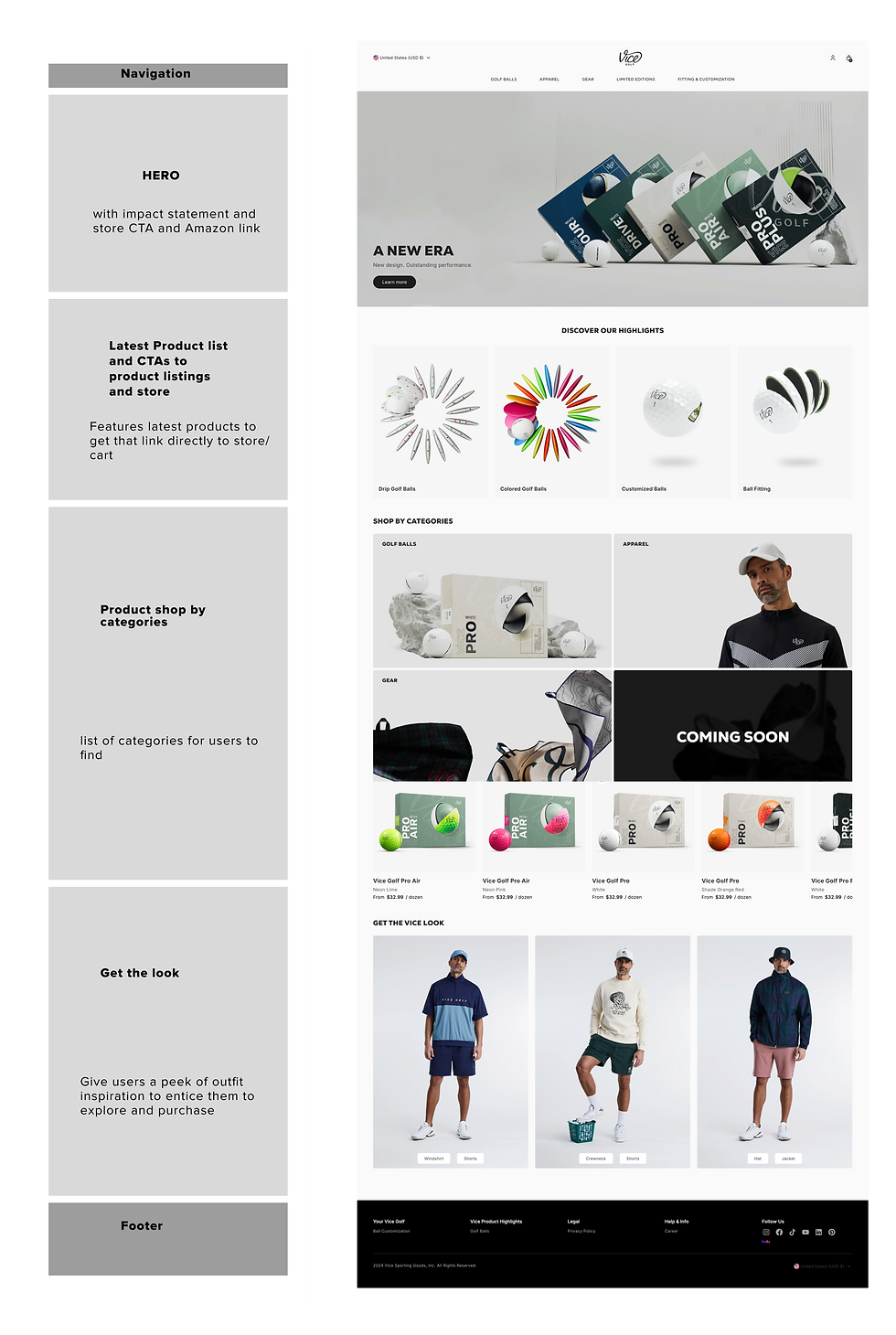
My approach to this product was a bit different in that the focus was moreso on style for an e-commerce website rather than designing a complex product. Thus, I performed lighter research on users and dove more in depth on analyzing competitive products to understand what made top industry leaders stand out.
I broke down the areas of competitor’s webpages to identify the purpose of each section. This helped me identify that emphasizing quality and impact upfront is crucial to allowing users understand the product, and allowing users to enter into the product page are priorities. Below is a competitive analysis of the home pages with respective zone diagrams:


TECHNICAL CONSTRAINTS
Technical Constraints & Feasibility
Given the tight timeline and my role as the sole developer, it was essential to design within the capabilities of the CMS I was using, Squarespace. To ensure feasibility and a smooth build, I evaluated Squarespace’s native components and functionality early in the process and used those constraints to inform design decisions. In several cases, I validated what was technically possible before designing, which helped avoid rework and ensured that the final designs could be implemented efficiently while maintaining visual quality and usability.


Retrospective
This was an incredibly rewarding opportunity as the founder was able to showcase the brand at events and gain sales. Seeing my designs come to life was surreal. Here are some areas that I took away from this project:
-
Fail fast: Although failing fast is usually used in terms of designing and testing features with users, I learned here that failing fast can also be done by sharing designs with clients and getting critical feedback from customers early.
-
Different design methods work for different projects: Due to the time limitation on this project, I determined that going straight into lo-fi wireframes versus sketching benefited me since I had a general structure in mind through doing a competitive analyses. This worked out well. Assessing the project needs can impact the design approach.
Special thanks to my client Tommy DeMarco for the opportunity!


